
I always call standardization the dirty little word in the DSO space.
The line lands half as a joke, half as a warning, from Clayton Russell, VP of Operations for Dental Care Alliance.
In boardrooms and strategy decks, standardization is rarely controversial. It promises clarity. It suggests discipline. It’s how a growing organization turns scattered activity into something repeatable and, eventually, scalable. But inside a successful dental practice, the word carries a different weight. To many clinicians, it can sound less like support and more like handcuffs.
Dentists are trained to make judgment calls and rely on experience to act in the best interests of their patients. When a new “standard” enters the room, it’s immediately judged on whether it will work with this team, with this patient, in the middle of an already full day. The concern is practical: What, exactly, is being standardized and what might be lost in the process?
For DSOs, the real work begins not with defining a standard, but with translating it.
“What can we actually get across the finish line?” Russell asks.
It’s a question that surfaces after the initial strategy is set. After preferred vendors are selected, workflows are documented, and systems are aligned, at least on paper. In practice, those decisions still have to move through dozens of locations, each with its own pace, constraints, and habits.
What, exactly, is being standardized and what might be lost in the process? […] The real work begins not with defining a standard, but with translating it.
Some of the friction is structural. As organizations grow, so does the complexity beneath them: different practice management systems, uneven adoption of digital tools, legacy workflows that don’t quite map to the new model. Even the data—arguably the clearest case for standardization—can fragment across platforms, making it harder to see the business as a whole.
Gad Zuaretz, CEO of Roligo Capital Dental Partners, believes the challenge isn’t just having data but knowing how to use it. Without clear visibility into what’s happening across locations, scale becomes harder to manage. Operators need to know what’s being used, what’s being remade, and where time is being lost from practice to practice.
But the more consequential friction is human. A standard doesn’t create leverage simply by existing. It creates leverage when it’s used consistently and predictably across locations that may never look exactly the same. And that kind of consistency isn’t enforced so much as it is earned, one conversation at a time.
What adoption actually feels like
For Dr. Layla Lohman, that gap between defining a standard and actually living is something she’s experienced from both sides. As co-founder and clinical director of Apex Dental Partners, Lohman helps guide clinical integration across more than 60 practices in the Midwest. But she also still practices chairside three days a week. That dual role—operator and clinician—has shaped how she thinks about change.
“I tried to be the cheerleader,” she says, recalling a practice management system transition in her clinic. “I knew it was good for us. I understood the why.” She paused. “I still hated it for weeks.”
The frustration wasn’t about the decision itself. It was the timing and context of the transition. The PMS platform was turning over, and Dr. Lohman had to learn a new system while continuing to see patients, manage a team, and maintain a consistent patient experience. Even with months of preparation, the change landed hardest in the moments that couldn’t be paused.
Standardization, then, can’t be a mandate about correcting inconsistency or performance. It’s a tool to introduce structure without stripping away what already works.
That experience reframed how she approaches standardization in her group today.
“Nothing prepares you for that change when you’re still in it,” she says. “That’s where most people underestimate it.”
Across DSOs, this is a familiar pattern. Leadership teams invest months evaluating vendors, mapping workflows, and aligning systems. By the time a decision reaches the practice level, it often feels complete and ready to deploy.
But to the clinician, it’s just beginning.
Why standards break down
Challenges and pushback rarely come because a standard is flawed. More often, clinicians resist because the standard arrives without sufficient support to survive contact with daily practice. Lohman describes her own shift in thinking as a move away from “standardization as script” toward something more flexible. Operational adjustment and centralization as a shared system, not a rigid directive.
“I used to think standardization meant doing the same thing every time,” Dr. Lohman confides. “Now I see it as creating a system that supports how you show up consistently.” When standards are perceived as prescriptive, they trigger resistance. No one likes being told what to do. But when standardized practices are framed and understood as supportive, they start to gain traction.
What to measure in the first 90 days
How to identify standardization attempts that may fail early. Measuring the metrics below can help operators understand where adoption is taking hold, where it’s stalling, and where additional support may be needed.
Training participation
Who is, and who is not, engaging with onboarding and training?
Workflow adoption rate
Are clinicians consistently using the new system, or reverting to previous habits?
Exception volume
How often and under what circumstances are teams operating outside the defined standard?
Data consistency and reliability
Are key metrics arriving on time and within expected ranges across locations?
Team sentiment over time
How are perceptions of the change evolving across clinicians and staff?
Still, even well-positioned standards can struggle to hold across locations. Part of the challenge is variability. No two practices operate exactly the same way. Differences in team experience, patient demographics, and existing workflows create natural divergence. What works seamlessly in one location may require adaptation in another.
The financial impact of that variability is rarely neutral. It shows up in lost time for various reasons: remakes, delays, and other inefficiencies that reduce the amount of productive chair time in a day. And across enough practices, those small differences compound into a major revenue leak.
But another part of the challenge is more subtle: interpretation. A standard can be clearly defined at the organizational level, but as it moves outward, it’s translated—by managers, by clinicians, by teams— into something that fits their environment. Over time, those small translations shift the practice and the standard drifts little by little.
Of course, the unspoken truth of acquisition is that many of the practices being asked to standardize aren’t underperforming. They’re the opposite.
“The reason you acquire these practices is because they’re high-performing,” says Russell, of Dental Care Alliance. Which means the variability DSOs are trying to manage is often the same variability that made those practices attractive in the first place. Standardization, then, can’t be a mandate about correcting inconsistency or performance. It’s a tool to introduce structure without stripping away what already works. That’s an important balance to strike.
Making standards stick
If defining a standard is a strategic exercise, making it stick across practices is something else entirely— operational, and often relational. For Lohman, that distinction came into focus through something that would affect clinicians every day: lab consolidation.
At scale, standardization stops looking like control and starts functioning like leverage—turning consistency across individual practices into a collective advantage.
Like many growing organizations, her group didn’t start with a tightly controlled set of partners. At one point, they were working with close to a 100 different labs across their network. Each relationship reflected a clinician’s preference, a local connection, or a routine built over time. Individually, those relationships worked. Collectively, they didn’t.
“We had to start narrowing it down,” Lohman says. “From a 100 to 25, and eventually, to 10.”
The goal wasn’t simply to reduce options but to build a system that balanced consistency with enough flexibility to earn clinician trust.
“There’s a difference between a vendor and a partner,” Lohman says. “A partner helps you deliver on your patient promise.”
That difference becomes most visible in the moments when practitioners are challenged most—complex cases, unexpected outcomes, situations where the “right” answer isn’t immediately obvious. In those cases, clinicians don’t just need a product. They need support. They need responsiveness. They need feedback that helps them adjust in real time. With the right lab relationships, Lohman found something shifted.
“I’ve taken on cases I wouldn’t have before,” she says. “Not because I changed, but because I had the support behind me.”
Across a multi-location organization, those dynamics begin to scale. With fewer lab partners, expectations become clearer and feedback cycles tighten. Over time, what was once variable becomes more predictable in both performance and cost.
From a financial perspective, the impact of standardization appears less as a single line item and more as a shift in the power of revenue operations across an entire network. Procurement becomes more efficient. Negotiation power increases. But the underlying driver remains the same: reducing variability so that each chair, each appointment, and each interaction operates as close to its potential as possible.
According to Gad Zuaretz, what changes when standards begin to hold is visibility. With consistent systems in place, operators can track performance at more a granular level—by location, by provider, even by case type—and identify where variation is creeping in. That visibility creates a feedback loop. Training improves. Workflows tighten. Over time, what was once unpredictable becomes measurable and then manageable.
“At the end of the day, it’s all about time,” Zuaretz explained. “If you can scan once instead of multiple times, if you reduce remakes, you’re not just improving quality; you’re giving that time back to the clinician.”
Making that shift still requires more than defining a preferred system. It depends on how those standards are introduced, how decisions are explained, and how trust is built over time. Clinicians need to understand not just what has been standardized, but why.
“Change is hard,” Lohman says. “But there’s a process you can use to help. Here’s the system. Here’s why we’ve created it. Here’s what challenge we think it will help you with.”
At scale, standardization stops looking like control and starts functioning like leverage—turning consistency across individual practices into a collective advantage. For DSOs, the question is no longer whether to standardize. The benefits of that decision are clear.
The real question is whether those standards can hold across different teams, systems, and ways of working. The advantage of standardization isn’t realized on whiteboards or in planning sessions. It’s realized when clinicians choose to use the partners and workflows in front of them without losing the judgment and adaptability that made those practices work in the first place.
As Russell puts it, “The DSO’s role is to serve offices by removing barriers, not imposing control.”
What we heard from operators
Consistent themes we heard across interviews:
Standardization most often fails at adoption
Most organizations have already done the strategic work. The challenge is getting consistent use across locations.
Clinicians need the “why,” not just the workflow
Adoption improves when teams understand the problem a standard is solving.
High-performing practices require adaptation, not replacement
Standardization works best when it builds on the foundation of what’s already working.
Fewer partners can deepen relationships
Consolidation reduces variability while improving support, communication, and predictability.
Change takes longer than expected
What looks complete at the leadership level is just beginning at the chairside level.
Support drives consistency more than enforcement
Standards hold when clinicians feel supported, not managed, by the system.
Standards without backlash
How leading DSOs drive adoption without sacrificing clinical autonomy
In a growing DSO, variability tends to show up everywhere. It appears in:
✓ How cases are submitted
✓ How materials are selected
✓ How treatment recommendations are explained
✓ How the practice and lab coordinate
✓ How quality issues get surfaced and resolved
Over time, even small differences from practice to practice can create friction that slows teams down, weakens trust, and makes it harder to deliver a predictable experience at scale. That is why standardization is so valuable for DSO operators.
But inside a clinical environment, standardization can be a loaded word. For clinicians, it can raise an immediate concern: are we trying to improve consistency, or are we trying to control clinical judgment?
To standardize, or not to standardize
Partnership is the most important element of systems standardization. This is often the difference between governance that gets adopted and governance that gets resisted. When every variable is treated like a non-negotiable, teams can start to feel boxed in. The most successful DSOs give practitioners visibility and agency in standardization decisions to help establish mutually beneficial systems. When organizations clearly define a set of shared standards and explain why those standards matter, they create alignment without stripping out clinical ownership.
When you have visibility into consumption, remakes, and trends down to the dentist level, you can start to see the hidden factors influencing the business. Most of the time, when you look at remakes, it comes back to training. And if it’s training, you can support it and improve it.
Gad Zuaretz, CEO of Roligo Capital Dental Partners
Areas to Standardize
- Quality and safety protocols
- Core digital workflows and case submission requirements
- Approved materials, indications, and manufacturing parameters
- Practice-to-lab handoff expectations
- Quality assurance processes and remake thresholds
- Escalation pathways for exceptions or complex cases
- Training and onboarding for new tools or workflows
- Performance signals that identify system breakdowns
Areas to Allow Flexibility
- Chairside judgment in individual cases
- How clinicians communicate recommendations to patients
- Treatment decisions based on clinical presentation
- Local team workflow preferences when outcomes are not affected
- Clinical approaches that fall within accepted standards of care
- Provider discretion in managing patient-specific needs
- Practice-level coaching and adoption pacing
- How teams work within the standard to deliver the best outcome
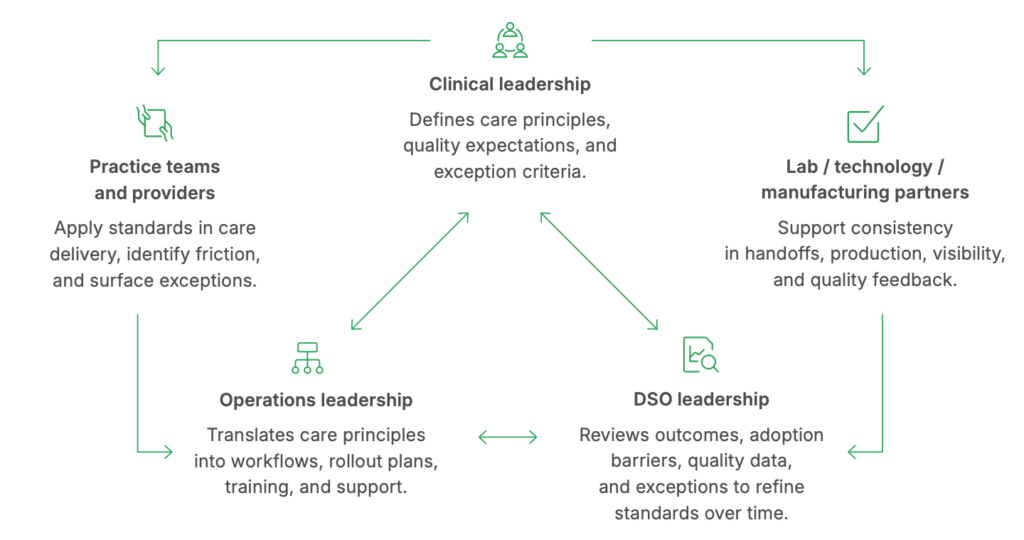
A working governance model
This kind of model makes one thing clear: Governance is a feedback system. The organizations that do this well understand that consistency doesn’t come from writing more rules. Instead, they put systems in place that make the right things easier for clinical teams to do every day.